Ed est responsable marketing chez GoJoe, où il contribue à la croissance mondiale de l'entreprise et travaille avec les clients pour soutenir l'engagement interne. Auparavant, Ed a travaillé pendant 8 ans dans la communication et le marketing pour l'équipe olympique britannique et dans le domaine des marques et des partenariats pour l'université de Portsmouth.
Quick answer: Most published metric lists stop at eNPS, turnover, and absenteeism, which only tell you who has already disengaged. Add leading signals — participation reach and benefit-use rate by team to see who is drifting before they leave. That pairing is how to measure employee engagement in a way HR can act on. Segment every metric by site, shift, and manager, review the set monthly instead of yearly, and treat a dip in one team as a prompt to act within weeks, not a line in a report.
Employee engagement measures the degree to which employees are committed to their work, their team, and their organization — and is best tracked through a combination of sentiment surveys, behavioral signals, and outcome metrics rather than any single score.
Engagement scores have become the metric executives quote and rarely trust. A survey result arrives once a year, averages out every team, and says little about why one site thrives while another quietly loses its best people. The stance here is direct: engagement is a health signal as much as a sentiment score, and treating it as a satisfaction survey alone leaves HR blind to burnout, benefits that go unused, and programs that reach only people who were already fit. Leaders who want a defensible number need a small set of metrics that connect feelings to behavior, update monthly, and show finance where action pays off. This guide lays out that set.
Points clés à retenir
• Measure engagement in three layers: sentiment, behavior, and outcomes.
• Add participation reach and benefit-use rate to your lagging metrics.
• Segment results by site, shift, and manager before you report an average.
• Review a short scorecard monthly, and run the full survey once a year.
• Tell employees plainly what data you collect and who sees it.
Why do annual engagement surveys fall short?
Annual surveys fall short because they arrive late, average every team together, and measure what people say, not what they do. A site can score 70% overall while one shift burns out, and the report hides it until resignations start. Surveys still matter for sentiment, but they work best as one layer of a larger picture.
How to measure employee engagement beyond the annual survey
Use three layers sentiment, behavior, and outcomes and track each one monthly by team.
Layer 1: Sentiment
Keep a short pulse survey and eNPS, the share of employees who would recommend your workplace. Ask five questions at most, and ask them on a fixed schedule so trends mean something.
Layer 2: Behavior
This is the layer most lists skip. Track participation reach — the share of participants who were previously inactive or flagged as at risk, not just total sign-ups. Add benefit-use rate by team and 30-day retention in any program. Knowing how to measure employee engagement through behavior tells you who is drifting before a survey does.
Layer 3: Outcomes
Voluntary turnover and absenteeism confirm what the other layers predicted. The national backdrop is tight: U.S. employers recorded about 3.1 million quits in August 2026, a rate of 1.9%, according to the Bureau of Labor Statistics. Your own rate by team shows where you're losing people.
What can employee wellbeing analytics show that surveys cannot?
Employee wellbeing analytics show where health risk is building, because they read live participation and activity data instead of waiting for an answer to a question. A drop in activity streaks on one team, or low benefit use after a stress theme in survey comments, is an early signal HR can check within days. Employers see aggregated, anonymized data only, which keeps the signal useful without exposing any individual.
How do workforce wellbeing analytics change your dashboard?
They add a view by team, site, and country next to your turnover chart, so leaders see which market needs attention first. Workforce wellbeing analytics also connect each signal to a funded benefit, which turns a warning into a next step. This is the Know More beat: live and predictive insight in place of a yearly snapshot. Health intelligence is the term for that approach.
How do you build a monthly engagement scorecard?
Pick one metric per layer, name an owner for each, and review all of them in the same meeting. Here is how to measure employee engagement monthly without survey fatigue: pulse score and eNPS for sentiment, participation reach and benefit-use rate for behavior, and voluntary turnover and absenteeism for outcomes. Pull workforce wellbeing analytics into the same review as turnover, so no team's dip waits for the annual report.
Set one trigger. When any metric falls two cycles in a row, its owner proposes an action within 30 days.
What should HR look for in a measurement platform?
Look for a platform that shows behavior and benefit data next to survey results, not in a separate portal. A good one makes how to measure employee engagement a monthly routine, not a quarterly project. Ask five questions in every demo:
• Can you show participation reach and benefit-use rate by team, site, and country?
• Does it show employee wellbeing analytics live, not as a quarterly export?
• How does it route employees to benefits we already fund?
• What do employers see, and what do employees control?
Engagement is the proof point to request. GoJoe achieves 80–90% average engagement in organizational challenges, which shows what a platform people actually use looks like.
How do you protect employee privacy when you measure?
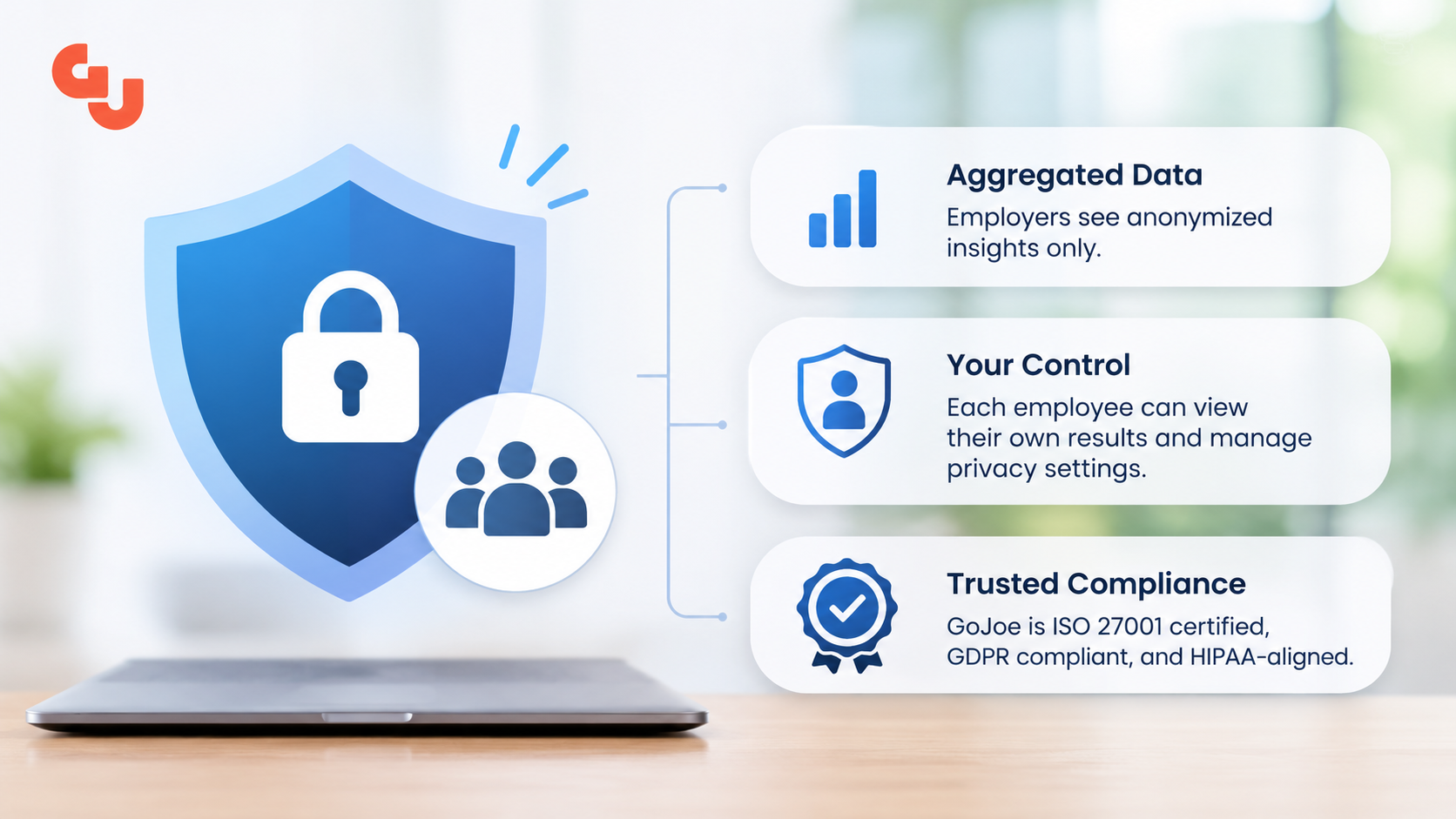
Employers see aggregated, anonymized data only. Each employee sees their own results and controls their privacy settings. GoJoe is ISO 27001 certified, GDPR compliant, and HIPAA-aligned.
State those rules in plain language before the first pulse survey goes out.
What should HR do first?
Start with one team and three metrics: a pulse score, participation reach, and voluntary turnover. Review them monthly for a quarter. That small step is how to measure employee engagement in a way finance trusts, because every number ties to a decision.
Know More. Spend Smarter. Perform Better.
GoJoe is the AI-powered health intelligence platform for global enterprise. It brings every health benefit into one place, routes people to the help they need, and rewards healthier living. Leaders get a live view of workforce health across every market. Book a demo.
GoJoe is the AI-powered health intelligence platform that helps global enterprises know their people better, get more from the benefits they already fund, and build a healthier workforce in every country they operate in. It is a corporate wellness platform that combines benefits navigation, wellness incentive and credit management, health risk assessments, rewards and team challenges in one system, used in 150+ countries.
What is health intelligence?
Health intelligence is the use of live and predictive data about a workforce's health, behavior, and benefits to help people get healthier, get more from the benefits they already have, and show employers what is working.
How often should you measure engagement?
Run a full survey once a year and a short pulse each month or quarter. Review behavior and outcome metrics monthly.
How are employee wellbeing analytics different from engagement scores?
Engagement scores capture sentiment from surveys. Analytics add behavior and health signals — such as participation and benefit use — so HR can act earlier.
Which metric shows disengagement first?
No single metric does. Falling participation and unused benefits on a team often move before resignations, but confirm the pattern with your own data.
Can one platform support employees in different countries?
Yes. GoJoe is deployed in 150+ countries and gives each employee a native-language experience.